It has been an interesting time since I have left. Fina’s ministry continues to blossom. As the Kid’s Club has really outgrown the
space on her front porch and her neighbor’s empty lot, she has now rented a piece
of land not far from where she lives and is constructing a facility that will
better meet the needs of the children, including a space for a “real” library.
 |
| Construction underway |
 |
| A little color helps |
 |
| transporting the benches to the new center |
 |
| Fina at the new center |
 |
| First meeting in the new center |
Meanwhile I work intermittently with Wycliffe Associates who
recently had a French proof-reading and translation project to be used in Burkina
Faso for one of their MAST (Mobilized Assistance Supporting
Translation) programs. I helped
clean up some formatting problems with some of the Notes used to assist Bible
Translators, and translated an English language PowerPoint presentation for use
there as well ...

Meanwhile, if you have been following the news, you will note
that the security situation has been deteriorating almost daily in Burkina
Faso. The latest map from the US State
Department indicates that virtually all provinces are off-limits to State department
personnel with the exception of Ouagadougou. There have been countless killings
and many churches, both Catholic and Protestant, have been targeted.
Below it the travel advisory from the U.S. Embassy :

It looks pretty grim. Only Ouagadougou and the surround area is "reconsider travel" and the rest of the country is labeled "do not travel." The French government's map is a little less frightening, but not much. Nowhere is travel considered "normal".
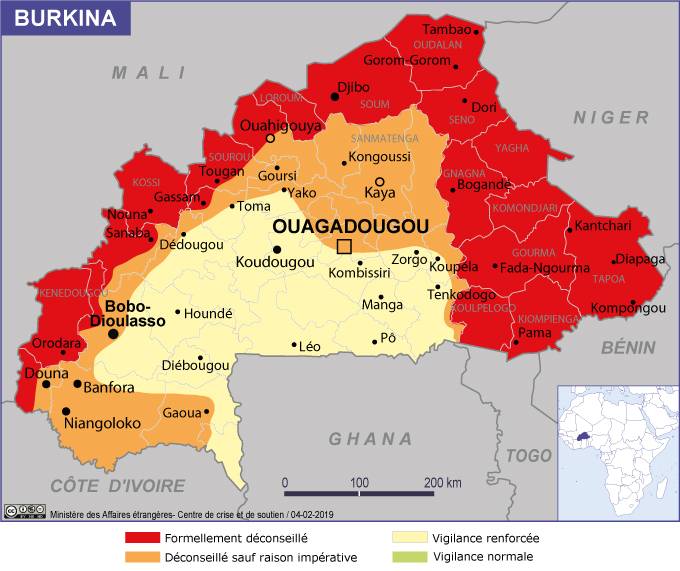
It is a complicated situation. A recent article (May 31, 2019) by the Armed Conflict Location & Event Data Project (ACLED) gives the following overview and assessment of what has been happening in recent months. In an article entitled A Vicious Cycle: The Reactionary Nature of Militant Attacks in Burkina Faso and Mali, Heni Nsaibia writes :
In recent weeks, a series of attacks on churches in Burkina Faso has received global media coverage (BBC, 2019). Jihadi militant groups recently accused of pitting ethnic communities against each other (HRW, 2019) are now also accused of trying to ignite a religious war (La Croix, 2019). **While jihadists do play a crucial role in the conflict in the region, focusing solely on these groups ignores the state’s role in the brutality. These church attacks not only reflect the growing capacity of jihadists in the region, but the states’ scorched-earth tactics — a fact the media has failed to highlight. **
The attacks in Burkina Faso have roots in neighboring Mali. The conflict in Mali has entered its eighth consecutive year and rages on despite multiple intervening efforts by French, UN, and regional forces. The conflict mutates as it spreads, and is becoming more brutal. Local populations in Mali have found themselves pinned between repressive government forces, ethnic-based militias, and jihadi militants. Violence in the neighboring countries of Burkina Faso and Niger has correspondingly evolved from mere spillover conflicts into full-fledged insurgencies (ACLED, 2019) in which mass-atrocities and summary executions have become standard practice. (Simon-Skjodt Center for the Prevention of Genocide, 2018). As of May 25, there were as many political violence events perpetrated by jihadi militant groups in Burkina Faso during 2019 than in the entirety of 2018. In early March, Burkinabe forces launched Operation Otapuanu in the country’s eastern regions in an attempt to quell the fighting. Despite being touted as a major success, the operation resulted in only temporary withdrawal by militants from the region, and in a corresponding increase in attacks elsewhere in the country — as shown in Figure 1 below (ACLED, 2018).
The increasing scope of the conflict — as demonstrated by these recent attacks on churches — reflects the behavior of regional states, more than the armed groups they fight. States in the region have failed to protect particular communities and, in doing so, fueled conflict, militancy, and insecurity through their use of ethnic-based militias. These militias operate in tandem with government forces, and occasionally with international forces. This was the case during the 2018 offensive in the Mali-Niger borderlands, which exacerbated tensions along ethnic fault lines and prompted mass-atrocities (ACLED, 2018). Similar events occurred in Mali’s “Pays Dogon” where Dozo militiamen allegedly massacred Fulani in Kologoun-Peulh and Ogossagou(RFI, 2019). In Burkina Faso, Koglweogo militiamen committed a massacre of Fulani in Yirgou and neighboring areas (VOA Afrique, 2019). Certainly, jihadi militants do exacerbate cleavages (The Conversation, 2019) However, by favouring certain communities and associated armed groups while stigmatizing and persecuting others, governments in Burkina Faso and Mali spur vicious cycles of violence amongst communities.
The attacks on churches in Burkina Faso are in fact reactions to the scorched-earth tactics of the state, and the militias they work alongside. Over the past months, attacks targeting the Christian community have been recorded in Sergoussouma, Boukouma, Silgadji, Dablo, Kayon, and Toulfé (see Figure 2 below); all took place in the context of military operations accompanied by grave human rights violations (HRW, 2018). Attacks targeting churches are not a novelty: central Mali saw an analogous trend in 2017 (Jeune Afrique, 2017), and these took place in a similar context. Koglweogo militiamen allegedly aid government forces by identifying members of the — largely Muslim — Fulani community involved in militant activities (Kisal, 2019), behavior that may provoke retribution against the perceived constituency of the Koglweogo. Similarly, the Malian armed forces cooperate with and use Dozos (traditional hunters largely drawn from the Dogon and Bambara communities) as guides and auxiliary forces, often spurring a response against these communities. As a result of this vicious cycle, these conflicts have become increasingly brutalized, intercommunal violence is intensifying, and the actors involved have become more relentless and indiscriminate. These developments have a negative impact on the population, but also on security forces, who face increasing risk of attacks by militants. Security forces have recently abandoned posts in areas under the militant influence such as Déou, Sollé, and Arbinda. In Tongomayel, security forces are forced to close shop in the evening and withdraw to Djibo due to the risk of attacks at night-time.
While church attacks by jihadists in the region make international headlines, similarly brutal tactics by the government and its allies — including summary executions of Fulani — fail to garner the same amount of attention. Nevertheless, this approach by government forces is, in part, the catalyst for violence practiced by militant groups in the region. The government’s tactics enable jihadi militants to present themselves as defenders of certain communities, and fast-track recruitment drives. While large-scale government operations may result in superficial short-term gains, the negative impact on the state’s relationship with the population quickly reverses these gains and causes the exponential expansion of militancy in Burkina Faso.
I've left off the charts included in the article, but you get the general idea, and I've bold-faced a few important points made. The once seemingly peaceful country where different ethnicities, languages and religions co-existed is now being torn apart. It is a sad thing to watch.
The sad thing is, mining exploration in the country has not only found industrial grade gold, zinc, vanadium, manganese, copper and titanium, but more recently is looking at possible oil and uranium reserves as recently reported in "Business Africa" on Africanews. All of these have not yet been exploited due to the volatility of the current situation. As Burkina Faso is one of the poorest nations in Africa, this could be a major boon for the country. Unfortunately, because of the recent instability and unrest, in what has for years been one of the more peaceful spots on the African continent, this is undermining this potential. It is most lamentable.

And then in today's New York Times there was this article that the terrorists appear to have shifted their goals from stoking conflict between farmers and herders to inducing a similar divide between Muslims and Christians.
In the light of all this, the director of SIL-West Africa has recommended that I go to the Côte d'Ivoire next year, and possibly "visit" Ouagadougou, but not stay there. Actually she had wanted me to go there before, and I did visit this past spring to do a needs assessment. The idea is that Ezéchiel should have finished his library training by then and she would like him to visit the SIL libraries both in Mali and the Côte d'Ivoire with me so that he has a better idea of how things function there.
Meanwhile, Ezéchiel continues to "message" me to keep me abreast of his life and studies and wants to make sure I am willing to critique his thesis which he should be presenting next month. He is currently doing an internship at the library of the French Cultural Center (L'Institut Français) there in Ouagadougou, which functions very much like a public library.
 |
| view of the Mediathèque (media center) at L'Institut Français |
 |
| Here is Ezéchiel's "selfie" inside the Bibliothèque (library) there |


No comments:
Post a Comment